MEDIA

Sign up for our complimentary tips and announcements:
[gravityform id=”2″ title=”false” description=”false”]
“Maria’s advice is wonderful and has been extremely valuable. I look forward to more high-quality, value-packed programs and mailings from her in the future.”
— Mindy Selinger,
— Link System Trainer
“Rock Your Platform: Build Audience Belief”
by Maria Guida
© copyright 2016 by Maria Guida. All rights reserved.
This article appeared in the May 2016 issue of Speaker, the official magazine of the National Speakers Association
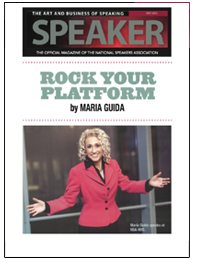 Would you like to enhance your credibility and authenticity factor on the platform? You can do it by applying a technique that actors have been using successfully for decades.
When you think of acting or actors, does “being phony” or “not authentic” come to mind? If so, you are thinking of bad acting and bad actors. The best actors seek truth in their work; the last thing they want is to have their acting “show.” They express the truth of the character and make everyone forget that they are acting. They make the audience believe that the actor
is the character.
»View a pdf of the article in its original format
“The Ronald Reagan Technique: How to Sound Natural While Reading Prepared Text”
by Maria Guida
© copyright 2016 by Maria Guida. All rights reserved.
This article appeared in the Jan/Feb 2016 issue of Smart CEO Magazine
 In business presentations, it’s crucial to engage listeners with a conversational style. That’s true even if you’re using notes or need to read some text verbatim.
Ronald Reagan, Franklin Roosevelt and Winston Churchill read a great many of their speeches as they delivered them to the audience. To do this successfully, they first became masters at reading a speech while sounding conversational.
Ronald Reagan used a strategy he learned during his years as an actor. The technique, called “See-Stop-Say,” is designed to help any speaker sound conversational, unscripted and engaging.
“Build Your Practice By Building Belief: A Lesson From the Theater”
by Maria Guida
© copyright 2013 by Successful Speaker, Inc. All rights reserved.
This article appeared in the May 2013 issue of The New York County Lawyer
 Attorneys have great deal in common with actors. They face negative stereotypes that they must continuously seek to destroy: actors are unreliable, phony airheads; attorneys are longwinded, arrogant sheisters.
How do successful attorneys and actors influence people to believe otherwise? How can you, as an attorney, help defeat these stereotypes and continue to build
your business?
“Speak With Poise, Passion, and Persuasive Power: Tips from the Theater”
by Maria Guida
© copyright 2009 by Successful Speaker, Inc. All rights reserved.
This article appeared in the March/April 2009 issue of the Association of Legal Administrators Magazine
 Research has shown that the impression that business speakers make on their listeners is influenced mainly by their visual and vocal impact. While many business speakers today focus on preparing content, they would be wise to increase the time spent on their visual and vocal style: how they deliver their message to persuade the listener. To this end, business people can borrow techniques that actors use.
“Don’t Make PowerPoint Your Higher Power”
from “Tips and Tales”, The Quarterly E-Newsletter of Successful Speaker, Inc., Volume 4 — April 2008
by Maria Guida
© copyright 2008 by Successful Speaker, Inc. All rights reserved.
PRESENTATION TIPS (The Summary)
- When using PowerPoint, position yourself front and center; be sure that the position of the laptop and screen allows you to take audience focus throughout the presentation.
- Plan how you will maintain audience focus on yourself while the slides are being changed gracefully.
- Draw audience attention to your slides as infrequently as possible; when necessary, do it briefly and refocus audience attention on yourself as quickly as you can.
PRESENTATION TALES (The Story)
Successful business speakers command audience attention and project authority. They know that PowerPoint and other presentation software are no more than support systems. In order to persuade an audience — to “sell” any idea, product or service — the speaker should be the “star of the show” throughout the presentation.
When I attended a presentation given by Martha, an attorney with a major New York law firm, I observed a problem found in much public speaking today: a weak performance caused by an over-dependence on PowerPoint.
Unfortunately, many business speakers use presentation software when it is unnecessary, and others use it poorly when its effective use could be helpful. Within many organizations, the use of PowerPoint has become an unexamined habit, rather than a considered choice.
“Take Stage!”
from “Tips and Tales”, The Quarterly E-Newsletter of Successful Speaker, Inc., Volume 3 — November 2007
by Maria Guida
© copyright 2007 by Successful Speaker, Inc. All rights reserved.
PRESENTATION TIPS (The Summary)
- When addressing a business audience, situate yourself in the position of power (usually front and center).
- Begin with both feet planted firmly on the floor and imagine that your feet are tree roots that extend deep into the ground. Stand away from furniture and other temptations to lean for support (when at a podium, stand tall). Keep hands/arms open and available for natural gestures.
- Take stage at every moment: at the end of your presentation, pause to receive and experience your applause with a smile.
PRESENTATION TALES (The Story)
How do actors get the audience’s attention and keep them riveted to the action of a play? One answer is that actors “take stage”: they inhabit the space with a “do or die” purpose and an attitude of complete belonging.
Business speakers, too, need to take stage during every speaking event. They must command the space and project passion about their message in order to persuade and inspire the business audience. The speaker’s position on stage, body language/gestures, and comments must all further this objective.
“Aretha Sang About R-E-S-P-E-C-T”
from “Tips and Tales”, The Quarterly E-Newsletter of Successful Speaker, Inc., Volume 2 — July 2007
by Maria Guida
© copyright 2007 by Successful Speaker, Inc. All rights reserved.
PRESENTATION TIPS (The Summary)
- Enunciate with clarity and pace that are respectful of the audience and appropriate for the complexity of ideas being expressed
- Use a speaking style that communicates respect for diversity: use your authentic speech at its best
- When referring to the audience and to third parties, choose words that honor their professionalism and sophistication
PRESENTATION TALES (The Story)
Effective public speaking for business communicates a respect for the audience’s intelligence, professionalism, sophistication, and diversity. Word choice, speech patterns, and the way we use our voices are all important aspects of public speaking that contribute to our success or failure in front of an audience.
Persuade Your Business Audience by Building Belief:
Lessons From the Theater
by Maria Guida
© copyright 2006 by Successful Speaker, Inc. All rights reserved.
Persuasive business speakers have a lot in common with actors. They know that the key to successful public speaking is to inspire belief within the minds and hearts of an audience. This is the founding principal for Successful Speaker training programs, which help business people achieve their goals for effective speaking. For application to the corporate arena, Successful Speaker has adapted and employs training techniques from the theater, so that business speakers can learn to persuade and inspire an audience the way the best actors do.
Persuasive business speakers and actors understand the key finding of a study conducted by the Harvard Business School:
Foreign-Born Professionals in American Business:
Communication Breakdowns Can Take a Heavy Toll
by Maria Guida
© copyright 2006 by Successful Speaker, Inc. All rights reserved.
Reprinted from HR Techknow
(Published by the Society for Human Resource Management)
Directors of Human Resources and Training routinely contact me with compelling tales of the communication challenges of some of the foreign-born professionals at their organizations and the negative impact these problems have on business relationships and the projection of a positive professional image.
When a Foreign Accent Isn’t Charming
The foreign-born professional with a significant pronunciation problem can cause distraction, confusion, and misunderstanding in business conversations, meetings, presentations, and phone discussions. Most non-native speakers of English do not receive the benefit of separate pronunciation classes during their study of English in the native country. To compound the problem, many who do attend such classes study with instructors who, themselves, are non-native speakers of English, speak English with a foreign accent, and have nevertheless been hired to teach American English pronunciation! One of the many difficulties faced by native speakers of other languages is that American English is not pronounced the way it is spelled. Without proper training, many foreign-born speakers use our spelling system as a pronunciation guide. This strategy usually causes mispronunciation and/or miscommunication, which can jeopardize one’s professional image.
Julie Ackerman quotes Maria Guida in her article, “Do As the Romans Do”
Reprinted from Matrix Magazine
(Published by NY Women in Communications, April 2007)
The idea of working abroad can be exciting but also a bit overwhelming. Depending on the country, language and cultural differences could prove to be a challenge. “Linguistic issues are half the problem,” says Maria Guida, a NYWICI member who has delivered communication skills training programs to Fortune 100 companies in the New York area through her company, Successful Speaker, Inc.